

Tell Me Why: Erin Malec on How Communications Drives Change
Erin Malec of the Southern Environmental Law Center shared how storytelling is rooted in strategy, values, and hope that can move people and shape public outcomes.
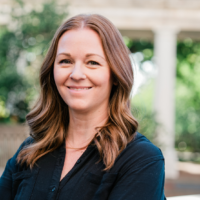
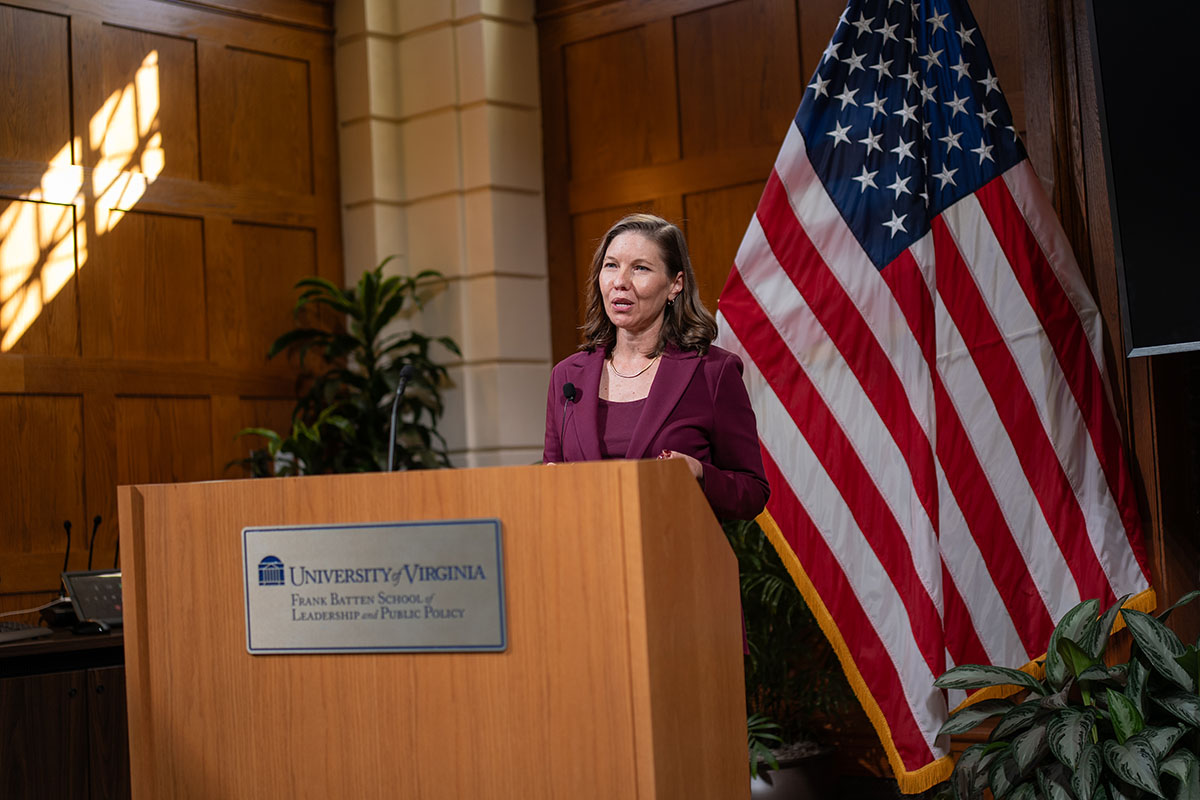
At Batten Hour, Erin Malec, the Communications Director for the Southern Environmental Law Center (SELC), challenged the idea that communication happens after the work is done. Instead, it is an essential tool that shapes outcomes and drives impact on public-interest work, she argued.
“How we tell stories is how we convey meaning, it’s how we entertain, it’s how we share critical information, it’s how we impart values,” said Malec.
From her 25 years in public-interest communications, including 13 at SELC, Malec has seen how storytelling can transform policy debates. “A lot of folks think that communication is used to report on an outcome. But in reality, communication has the power to shape the outcome that we’re trying to achieve. It can often be the determining factor on what we are trying to achieve, if we are able to do so or not.”
Malec’s perspective is shaped by her work at SELC, the largest environmental legal nonprofit focused on the South. With the decline of local journalism and the fragmentation of national news, her team has adapted. “We think of ourselves as our own media company,” she explained. “How can we produce content to deliver directly to audiences so that we’re not dependent on the media to reach the right people?”
She urged attendees to think strategically before jumping into tactics. “Always start with the strategy and really ground yourself in the clarity of what you are trying to achieve,” she said. “What is the goal we’re trying to achieve, and the strategies that will help us get there?” Once that strategy is clear, she said, the next step is to identify the right audience. “If you are talking to everyone, you’re usually talking to no one.”
From there, Malec shifted to storytelling itself, the heart of her talk. “We very rarely tell them why. We skip the why part,” she said, referencing Simon Sinek’s Start with Why. Stories, she explained, can persuade in ways that data alone cannot. “When you tell someone a personal story, and then you tell them contradictory facts, they choose to not believe the contradictory facts if they have heard the story first.”
She also emphasized that good communication connects to a values level. “We all exist in the world with unconscious beliefs of our values that really shape how we see the world, and good messaging is aware of that,” she said. “I do believe that we have more in common on a values level than you would think if you looked at our current, very fractured political environment.”
But effective storytelling, Malec reminded the audience, requires hope as much as urgency. “If you go the added step of not just communicating the problem, but also communicating that there is a path forward with a solution, and connect it to the action people can take individually or as a community, that is when you really start to see change happen.”
Language and imagery, she said, can make or break that message. “I think there’s an emotional difference between talking about a house versus a home,” Malec noted.
Malec reminded attendees to keep their language simple and human. “The longer words you use, and the more complicated you talk about an issue, the less credible and intelligent people think you are,” she said. Even experts, she encouraged, should weave in personal reflections. “There is animation and conviction in telling stories, and that’s what humanizes an issue,” she said.
She left the audience with a reminder that sums up her philosophy: “The best arguments in the world won’t change a single person’s point of view. The only thing that can do that is a good story.”