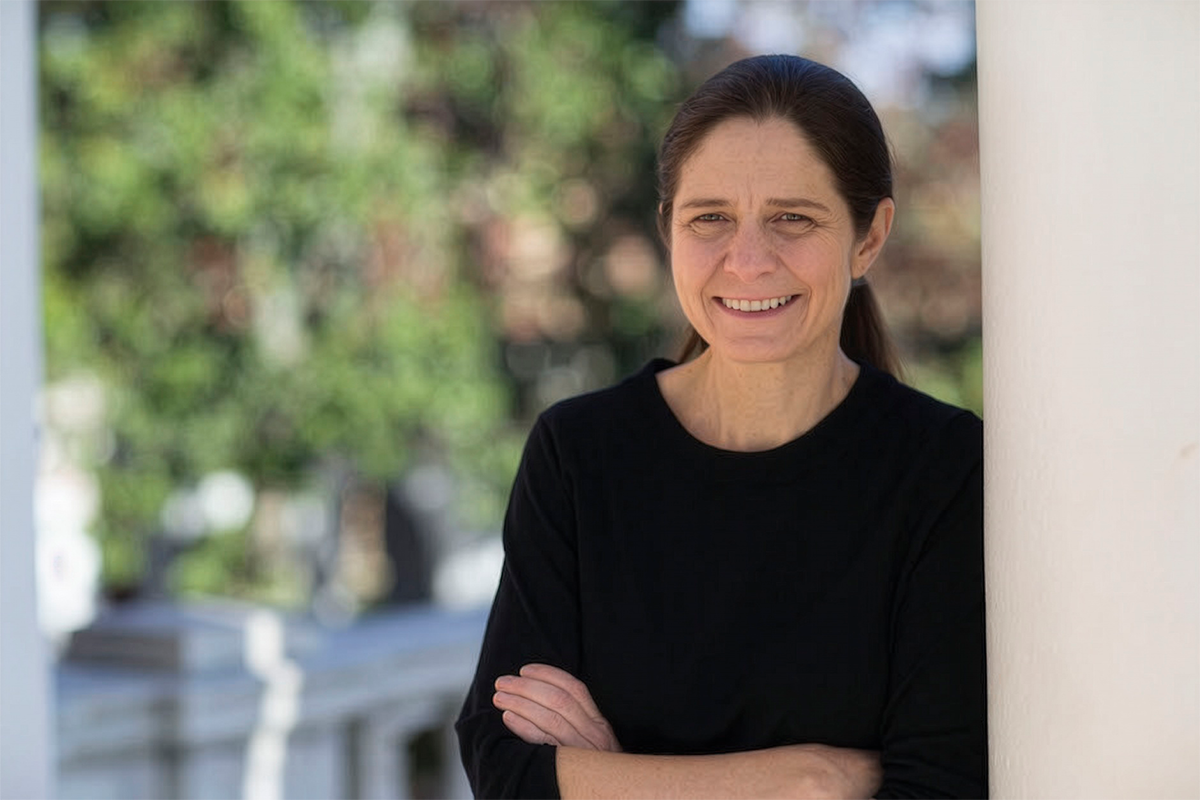
Sarah Turner is a professor at the University of Virginia, with appointments in economics, education, and public policy. Turner is a leading expert in labor economics and the economics of education, focusing on higher education and high-skill labor markets. With more than 25 years at UVA, Professor Turner has taught thousands of students in multiple schools and departments and chaired the department of economics from 2013 to 2016.
In 2024, Education Week’s RHSU Edu-Scholar Rankings named Professor Turner among the most influential education scholars in the United States. She was also awarded the Jefferson Scholars Foundation Faculty Prize in 2023 for her commitment to leadership, scholarship, and citizenship.
As part of our Women’s History Month celebration, we asked Professor Turner some questions about her research and her career at UVA.
Why did you choose to become a professor, and what led you to study the economics of education?
Given the long history of UVA, it seems like I just arrived! I don’t know that I “chose” to become a professor — my engagement in research began as an undergraduate, and from there it was a trajectory through graduate school that felt more like serendipity and momentum than a deliberate choice.
It’s worth noting that “economics of education” wasn’t really a field when I was in graduate school. It’s been in the 25 years that policymakers and social scientists have really focused on using methods, data, and models — often from economics — to improve educational outcomes. We spend about $1.6 trillion on education in the U.S., roughly 7% of the country’s Gross Domestic Product (GDP). It’s incumbent on researchers and policymakers to make sure that money is well spent. That’s a research agenda that doesn’t get old.
What do you think is unique about UVA Batten’s philosophy and principles?
What I think is terrific about Batten is the emphasis on bringing social science principles to ideas of leadership and implementation in the policy sphere. That combination of rigor and action is unusual and, frankly, needed. I’ll also note that the engagement of both undergraduate and graduate students makes for a special community. It keeps the conversations lively and the questions fresh.
What inspires you about teaching or interacting with UVA students?
Curiosity, good spirit, and enthusiasm. I’ve been teaching at UVA for over 25 years (and associated with Batten since its founding). What keeps it interesting is that every cohort of students brings new questions and lots of energy. The students push me to think freshly and hard — which, given that I study education for a living, feels like the system working as intended.
Is there any career or life advice that you wish you could offer your younger self?
Be patient. Good research takes longer than you think, and the questions that matter most are rarely the ones with quick answers. Also: learn to say “no” — politely. Your calendar won’t do it for you. Economics teaches about opportunity cost and making choices at the margin: applying those principles in time management is essential.
Since this is for Women’s History Month, are there any research findings you’d like to highlight specifically related to women in higher education or high-skill labor markets? Are there any recent education or economic policies that support women that you’d like to highlight?
Women have come a long way in their representation in STEM fields and leadership positions at research universities. When I started as a professor, economics departments routinely had few women among the tenured ranks. That’s changed meaningfully, even if not all barriers have been broken. Progress isn’t automatic; it takes intentional effort by departments, institutions, and mentors. But there has been a lot of progress, and it’s worth celebrating.
Are there fellow UVA faculty, other education scholars, or policy leaders who inspire you?
It’s hard to single out names when you’ve been fortunate to have so many mentors who opened doors and invited you to interesting conversations at UVA and beyond. I’d inevitably forget someone. But at the moment, I’ll give a shout-out to Amalia Miller, Chair of the Economics Department, and Eileen Chou, Associate Dean for Academic Affairs at Batten. As a “retired” department chair, I can tell you these are among the toughest jobs at the University, and these women are doing extraordinary work. Leading an academic unit well is its own form of public service — unglamorous, largely uncompensated, and absolutely essential.