Congress is back from its August recess, and lawmakers face public demands for action on issues as varied as health care, infrastructure, gun safety and trade. Legislators face at least one set of “must pass” agenda items: 12 spending bills that need to be enacted into law by Oct. 1 or the federal government will shut down.
What else is Congress likely to work on? Keep your eyes on party leaders’ signals. Once, Congress’s committees incubated policy solutions. But congressional leaders have steadily reduced the power of committee chairs over the past two decades, bringing that power to a new low in the 115th Congress (2017-2018). Party leaders now drive the agenda. To see what, if anything, might happen in Congress this fall, listen to what the House Democratic and Senate Republican leaderships are pushing.
Here’s how we identify effective lawmakers
To figure out where legislative power lies today, we trackedall 248,915 public bills introduced in the House and Senate since the early 1970s. We coded the bills for their substantive importance and how far each bill made it through the legislative process toward enactment into law. We tied each bill to its sponsor and then used data on bill progress to identify the most effective lawmakers in Congress.
Unsurprisingly, majority-party members outperform those in the minority, and senior members outperform freshmen. Committee and subcommittee chairs outperform rank-and-file committee members, as do those in the majority party’s leadership. For example, in the 115th Congress, Reps. Michael McCaul (R-Tex.) and Bob Goodlatte (R-Va.), chairmen of the House committees on Homeland Security and the Judiciary, respectively, managed to move more bills toward law than almost any other legislators in the House. On the Senate side, Charles E. Grassley (R-Iowa) and recently retired Orrin G. Hatch (R-Utah), who chaired the Senate committees on the Judiciary and Finance, respectively, were the most effective lawmakers.
Committee and subcommittee chairs (especially in the House) have always been relatively powerful compared with other members of Congress. But according to our Legislative Effectiveness Scores between the mid-1970s and the mid-1990s, rank-and-file members in the House performed essentially the same whether they were in the majority or minority party. While members of the majority party were, on average, more effective than minority-party members at advancing their bills through the lawmaking process, that boost came not from the rank and file but from the powerful committee and subcommittee chairs — all of whom were members of the majority party.
Party leaders now eclipse committee chairs as more effective lawmakers
As the figure below shows, chairs no longer stand out as more effective lawmakers than party leaders.
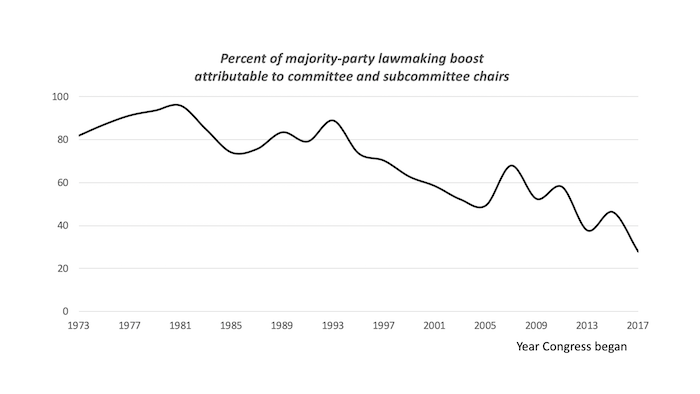
The scores we released this year show that committee chairs’ power continues to decline. That decline slowed briefly after switches in party control of the House in 2007 (to Democrats) and 2011 (to Republicans) — perhaps because these new majority parties were slow to consolidate agenda-setting powers in the hands of their leadership immediately after taking the House. But in 2017-2018, chairs’ lawmaking influence had fallen to just a third of its 1981 peak.
Why the decline? When Republicans gained control of the House in 1995, Speaker Newt Gingrich (R-Ga.) sought to consolidate power with Republican leadership and pushed through changes. Most significantly, Republicans imposed term limits on committee chairs. That diluted their power; fellow members of Congress knew that the chairs’ time pounding the gavel would be relatively brief. These changes reduced expertise — and limited Congress’s overall ability to solve policy problems.
Further, as Democrats and Republicans have battled for control of Congress, each party has sought to advance a common and unified message — often placing electioneering over policymaking. To maintain unity in messaging, party leaders have set the committees’ agenda — and reduced committee chairs’ power and effectiveness.
Party leaders’ competing agendas this fall will likely prevent much action
Until 1994, as we tried to understand what Congress might do in the fall, we would have spent August looking over recent committee actions. We would have focused on how experts weighed proposals’ costs and benefits, and examined how chairs were prioritizing different bills as part of their broader agendas and negotiating with their committee members of the specific legislative details of potential policy solutions.
But with the chairs’ and committees’ waning influence, we now look to party leaders. Those leaders often seem to be focused on proposals that will help them keep control of the House or the Senate.
For instance, Speaker Nancy Pelosi (D-Calif.) has been publicly pushing the Senate to take up the House’s gun legislation — a focus that will probably highlight differences between the parties’ priorities.
That’s not true on everything. For example, both parties seem interested in negotiating a revamped North America trade deal, lowering drug pricing and eliminating surprise billing for medical treatments. Given that Democrats control the House and Republicans control the Senate, however, we can expect nothing to happen on many of these issues. If congressional leaders are aiming primarily at winning elections, compromise is counterproductive. Only one party can win the chamber — and if that involves demonizing and defeating the other party’s proposals, there’s little incentive to make a deal.