(Editor’s note: This excerpt is taken from ”The Friday Cover” story for Politico, January/February 2018, and posted with permission.)
An algorithmic lobbyist sounds like a joke. But it’s already here. Here’s who the robots are coming for next.
——
Tim Hwang…is the CEO of a four-year-old firm called FiscalNote, which makes a kind of technology that is quickly raising questions about who—or what—is still an essential player in Washington.
Hwang, in sharp-edged glasses and a blue blazer, taps on his MacBook Air, and what appears on the screen is a full assessment of the legislative record of Senator Orrin Hatch, the 83-year-old Utah Republican (who has recently announced his retirement.)…
Jennifer Doleac, Assistant Professor of Public Policy and Economics at (Batten), is one of the handful of social scientists in the United States closely studying the practical and ethical questions of extending automation into public decision-making.
“You could imagine feeding information into a computer that says, ‘Yes, this person’s eligible for benefits or not,’ instead of just looking at a file and say ‘yes’ or ‘no’ based on their hunch about whether the person needs the money,” says Doleac…
Across the country, criminal courts have started to rely on algorithms to help judges decide things like whether a defendant should stay in jail while awaiting trial.
Doleac…looking at the future of algorithmic decision-making, founded and runs a center at (UVA) called the Justice Tech Lab in response to requests from law enforcement and others for help figuring out how to best apply new technologies to criminal justice.
“Humans are easily distracted by irrelevant information,” says Doleac, “and computers are much less easily distracted by that stuff.”
The factor that limits whether robots start rendering more decisions in the criminal justice system is less technological than that “people aren’t totally confident in computers making decisions yet,” says Doleac.
But that doesn’t mean robots can’t augment those judgment-renderers’ brains. While the Supreme Court, as a rule, hears cases too complex for algorithms to help much, Doleac says, one place they could is on deciding stays in death-penalty cases.
A computer could tell the justices how likely the case before them is to eventually be overturned, giving them insight into the wisdom of stopping that particular execution…
The machines we’re coming to trust with our lives don’t have to be perfect. They just have to be better than humans. And when it comes to the courts, says Doleac, judges make mistakes. They can, like other humans, be ruled by hunger and anger and misunderstandings.
Even if robots are only just as good as their human counterparts, Doleac points out, they’re cheaper and easier to replicate…
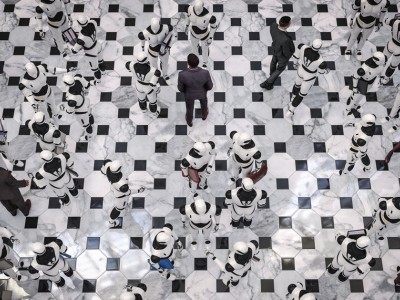
(photo illustration courtsey of Justin Metz)