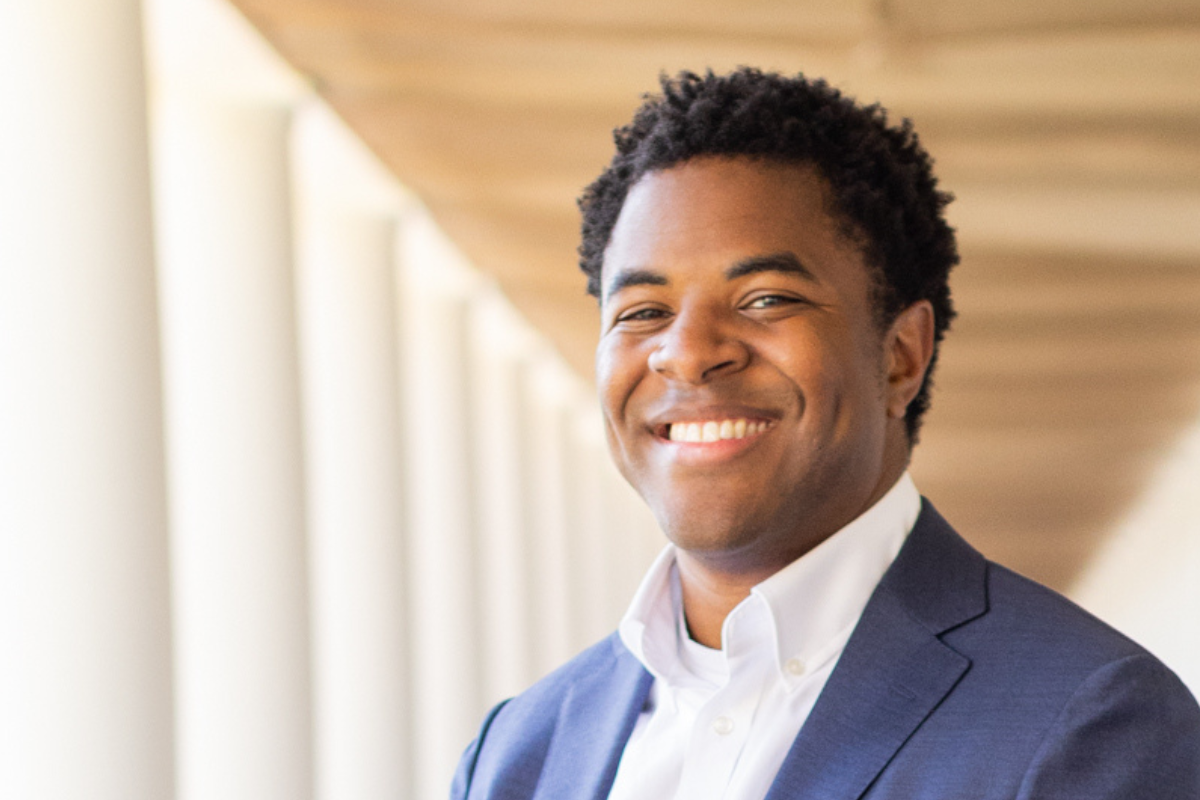
New research from UVA Batten assistant professor Kyle S. H. Dobson has identified a simple and cost-effective method for improving police interactions with community members that requires only ten small words.
Dobson and his co-researchers found that an officer stating a benevolent intention up front — something as simple as, “I’m walking around trying to get to know the community,” — made a substantial difference in how community members responded.
Published last month in Nature Communications, the paper by Dobson and co-author Andrea Dittmann, an assistant professor at University of Southern California Marshall School of Business, sheds light on a fundamental dynamic in police-community relations and offers solutions that could ultimately reduce crime, improve community safety and welfare, and save lives. The paper, “A transparency statement improves trust in community-police interactions,” won the Best Conference Paper Award in 2023 from the International Association of Conflict Management.
“I saw it over and over again, unfortunately, this illusion of rapport, this gap between what police thought was happening, which was them building relationships positively, and the experience of the community members, who felt like they were being more or less racially profiled or harassed,” said Dobson, who joined the UVA Batten faculty as an assistant professor of public policy and psychology in 2023.
Dobson has spent years working with law enforcement agencies and communities across the country to understand why “community policing” too often does not achieve the goal of improving relations between the two groups. The paper notes that although a majority of police departments have adopted the approach over the past decades, public trust in police is declining, and crime has not decreased.
Dobson and his co-researchers observed that because the first words in a conversation set the stage for everything that follows, officers have to be mindful of what they say, as well as how they say it, especially given the inherent power differential, Dobson said. “For police, they are literally wearing the identification of exactly who they are when they approach someone in a park, on the street, or wherever.”
And the initial few moments are critical, he added. If officers briefly stated their benevolent goal upfront, it could prevent a tense situation from escalating into a wrongful arrest, violence, or worse, the researchers found.
To test this idea of a “transparency statement,” they started with collaborations with several police agencies for more than 500 hours of field observation and then conducted experiments with thousands of participants. Community participants, who were not told the exact nature of the field experiment in-person, wore stress sensors to gauge their physiological reactions to police interactions.
Dobson and Dittmann found that when officers were not transparent about their intentions, community members felt threatened, afraid, nervous, or upset, and responded with hostility. For example, an officer stating, “Hi, I’m Officer [Name], how’s it going? Can I talk to you for a minute?” tended to put the other person immediately on defense. But when police were transparent by starting with, for example, these ten words – “I’m walking around trying to get to know the community” – people were less than half as likely to feel negative emotions.
They also found that twice as many community members reported feeling inspired by the end of interactions when officers made a transparency statement than when they did not, and that people of color and those who have a history of contact with the police may benefit more from greater transparency.
Transparency statements – relatively simple, low-cost, and readily applied – may have the potential for scalable intervention, which could translate into more collaborative police-community relations and reduced crime at significant cost savings, Dobson said. “This isn’t the thing that will change everything we need to about policing, but I think we need to pay very close attention to what [officers] are saying and give them guidance.”
Dobson continues to expand his research, partnering with police departments and others around the country to train officers in this practice and to train the trainers, as well as to provide policy recommendations.
“If a policy says to treat people with respect and dignity, my critique is that that’s not specific enough to implement and keep people accountable,” he said. “Instead, let’s write something into the policy that says exactly what they should do in order to have positive effects.”
###