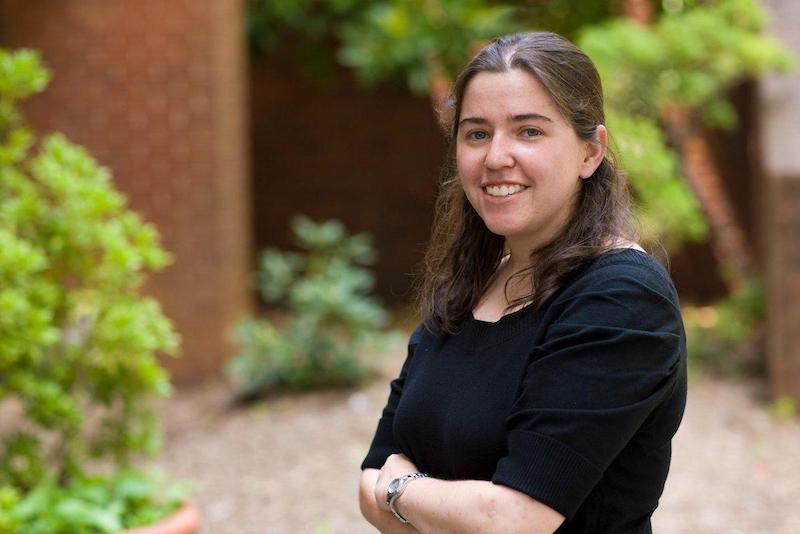
Daphna Bassok first became acutely aware of the importance of early childhood education when she taught in a kindergarten classroom. The difference in readiness between the children who came into her classroom with preschool experience and those without was striking, she said.
Today, Bassok is an associate professor of public policy and education at the University of Virginia’s Frank Batten School of Leadership and Public Policy and the Curry School of Education and Human Development. She researches early childhood education, with a focus on state efforts to improve early learning opportunities, particularly for low-income children.
The associate director of EdPolicyWorks, a collaboration between Batten and UVA’s Curry School of Education and Human Development, Bassok is the principal investigator on a project supported by the U.S. Department of Health and Human Services’ Administration for Children & Families, in which she is examining the state of Louisiana’s efforts to overhaul its early childhood education system. She is also the principal investigator on an evaluation of Virginia’s Federal Preschool Development Grant, which aims to support early educators in the commonwealth.
On Nov. 8, she received the 2019 Raymond Vernon Memorial Award from the Journal of Policy Analysis and Management for a paper she co-wrote on how to improve the quality of early childhood education.
Batten School writer Molly Hannon sat down with Bassok to discuss her current work and upcoming projects.
Q. How did you become interested in early childhood education?
A. I first became interested in early childhood education when I was a teacher working with kindergarten, first- and second-graders in a school out in Seattle. The school served elementary school children, but it also had early childhood classrooms for children birth through age 5.
I was so impressed with the early childhood educators and all the learning happening in those classrooms. Most of the children I taught had already been in our school for a few years before kindergarten and came into my class knowing so much, both as far as early literacy and math, but also how to problem-solve, work with others, etc. It was striking to see the differences between these children and children who came into kindergarten without a similar preschool experience.
This got me interested in the role of access to high-quality, early childhood education opportunities for addressing inequality, and the role of public policy in improving access.
Q. Can you tell me how your partnership with the Louisiana Department of Education developed?
A. My partnership with Louisiana started in 2013 after I read an article about ACT 3, which mandated a major overhaul of their early childhood system. They were taking a number of proactive steps to bring together all the publicly funded early childhood programs in the state, including subsidized child care, Head Start and pre-k, into a more coordinated system.
They were also introducing a really different approach to quality improvement: an accountability system focused on improving the quality of teacher-child interactions. I reached out to Jenna Conway, who was the superintendent of early childhood at the Louisiana Department of Education, and told her we’d be very happy to do some research and evaluation to support the pilot phase of the reform if she was interested. She was incredibly open to the offer and very interested in data and evidence to help shape their efforts. She invited me to fly down and meet with her team, and we have been partnering together ever since.
Q. What are your goals with the next stage of the Louisana project? How can partnerships such as this one help improve access to high-quality early childhood opportunities?
A. Our goal is to tackle questions identified by our state partners as critical for improving early childhood, with a focus on how to support early educators.
In Louisiana, they recently started requiring all child care teachers to earn a credential within two years of working at a center. The policy is unique for a few reasons: The state pays for the cost of the credential; they provide teachers who earn the credential a meaningful increase in pay; and they work to ensure the credential experience is focused on giving teachers skills that will really support young children.
Our study, which I’m leading with UCLA’s Anna Markowitz, is about understanding the effects of this new policy and is also about finding ways to support child care workers as they work toward this new credential. Our partners and early childhood policymakers nationwide are trying to find effective ways to support early educators, and the goal of this work is to provide rigorous new evidence about one promising strategy.
Partnerships such as this one ensure that researchers are focusing on problems and issues that are immediately relevant to policymakers. Policymakers are very interested in evidence and data, but don’t always have the capacity or time to invest in gathering this information. Partnerships like ours can help fill that gap.
Q. Can you tell us a bit more about the work you’re doing with the Federal Preschool Development Grant here in the commonwealth?
A. A little over a year ago, Jenna Conway, who actually grew up in Charlottesville, left her position in Louisiana to become the chief school readiness officer for the state of Virginia, where she is now working to improve access to high-quality early childhood education in the commonwealth. Since we had years of experience partnering together in Louisiana, it was natural to continue the partnership work now that she is here.
This year, Virginia was awarded a Federal Preschool Development Grant, and my team at UVA has led the evaluation component. Working closely with the Virginia Department of Education, we have been studying ways to support Virginia’s early childhood workforce. We’ve been helping to design and evaluate a pilot program to reduce teacher turnover, which is a major problem in early childhood settings. In particular, we are currently conducting an experiment to test the effects of financial supports for early educators on their well-being and the likelihood they stay in their positions.
Q. How does your research inform your work at EdPolicyWorks and also in your practice as a professor?
A. At EdPolicyWorks, we are committed to doing education policy research in close partnership with policymakers, and we try to embed our students at every stage. Right now, our team for the early childhood work includes undergraduate, master’s and doctoral students, and post-docs, working together with our partners in Louisiana and Virginia.
Our students are spending time with the policymakers; they are getting to make presentations to superintendents and sit at the tables where policymakers decide how to roll out policies.
Bassok’s co-authors on the paper in the Journal of Policy Analysis and Management were Thomas S. Dee of Stanford University and Scott Latham of Princeton University. Dee worked at UVA from 2010-12 as a research professor of education and professor of public policy and economics.